This isn’t so much a blog post but more personal musings about just where my painting is going.

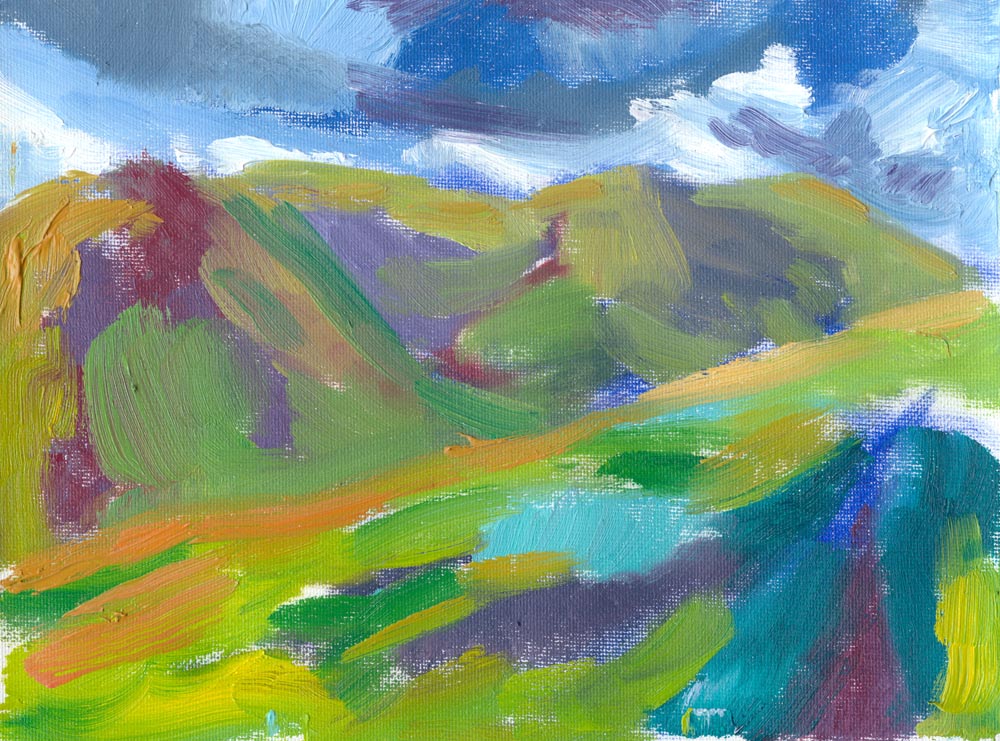
Duirinish coast, Skye, oil on 16″x20″ board, image itself around 13″x19″
Some paintings have more or less drawing in them than others. Sometimes, as in the picture above, mine are mainly drawn.
I’ve been thinking about the kind of painting I want to do, about the way my work is developing, and looking at the artists I admire such as Bomberg, Nolde and – a new favourite of mine – the Berlin plein air painter Christopher Lehmpfuhl. Another painter I like is the British plein air artist George Rowlett, whose pictures I saw being exhibited at Brantwood, Ruskin’s house on the shores of Coniston, in 2012.
There are big differences between these artists in the ways that they approach painting. Bomberg and Lehmpfuhl prioritise drawing in their paintings it seems to me, with Lehmpfuhl (examples of whose work can be found here) using colour quite sparingly, while Bomberg glories in wonderfully rich colours in his later work, using colour to make painterly marks as well as to draw the lines that tie the picture together. Many of his works are now on the BBC’s “Your Paintings” website.
Another one of my paintings which contains a lot of drawing is this one, of a view from the fells:

looking down Settlebeck Gill, oil on board, 14″x18″
Rowlett doesn’t seem to draw so much in his paintings but he appears to see incredibly clearly the tones and colours in front of him and recreate them in accurately yet freely realised shapes so that everything is just where it should be and glowing with wonderful hues. I’m about to order a catalogue of his paintings from the gallery which represents him in London, with pictures from London, Kent and the Lakes.
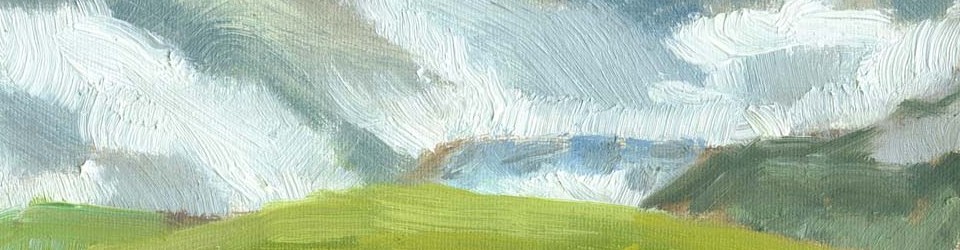
My own paintings aren’t consistent in that some have relatively little drawing in them:

cloud study, oil on canvas, 6″x8″
Nolde is at a distance from the others really, although elements of his style, such as frantically applied strokes building wind and waves, I think I can see in Lehmpfuhl’s work. I recently bought the catalogue that goes along with this exhibition and the pictures show Nolde revelling in colour and seeming to throw caution to the winds, allowing his paintings to form imaginary scenes that should be far too crude to work but somehow seem powerful and exotic instead.
He is the most difficult one to get to grips with of all of the painters I admire – it seems impossible to understand how he gets away with it. All I have worked out so far is that the compositions tend to be arresting to begin with and he manages to make his colours appear extremely vivid without cancelling one another out, using some kind of magic I can’t follow.
I have tried to add my own memories, mystery and feelings to my work and this painting is one which had a slightly mystical atmosphere, I thought:

Neist Point lighthouse, Skye, oil on card, image approx. 10″x12″, card around 13.5″ wide.
Being able to paint from the imagination and succeed in creating powerful work is something I can’t do, although I know every painting is really partly “made up” even when it’s a plein air or still life. There will always be some of it that comes purely from the artist’s mind. You could also say that all paintings are made from memories as well, even if that memory is only a fraction of a second old as you look from subject to canvas.
So, in paintings there are drawing and colour, imagination and memory. All of these can be prioritised to greater or lesser extents. I know I love the depth that drawing can add to a painting – that solid, three-dimensional, spatial quality that allows you to feel you could fall into the picture – so I don’t think I want to give up drawing in my work. Getting drunk on colour is also something I relish and I’m constantly attempting to increase the use of colour in my work.
Imagination and memory haven’t been major considerations for me so far but I’ve found that filtering work through more than one medium (painting a watercolour on the spot then translating it into an oil of a different size later) can allow unexpected qualities to creep in to a picture. Returning to the same subject and making many studies, and having a strong emotional pull towards it in the first place, can skew a finished painting so that it becomes more interesting, with more of the mind in it and less sterile objectivity.
In the wake of these artists I admire, all of whom have painted en plein air, I will flounder joyfully and veer between drawing, colour and imagination …